
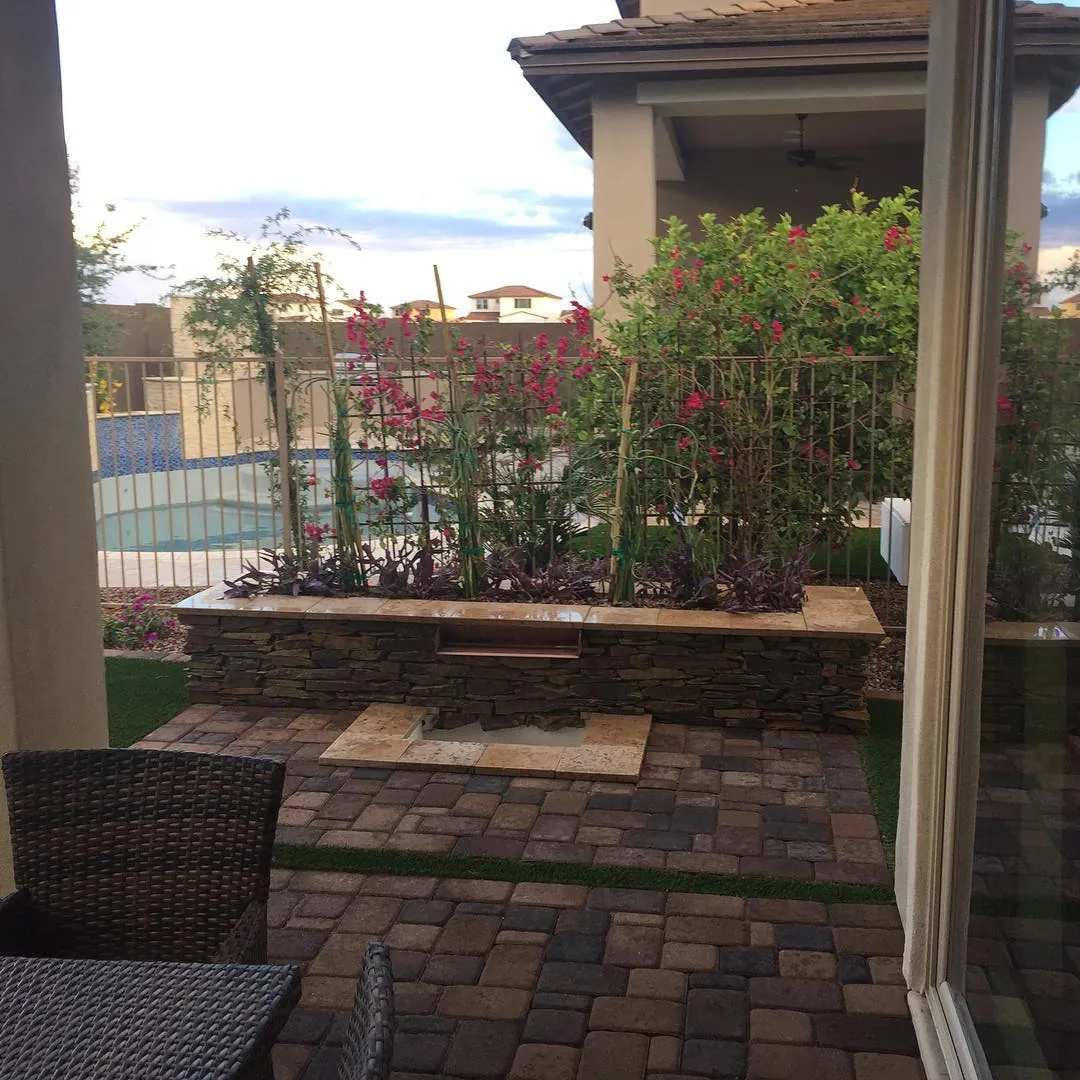
Raised planters capped in stone
Green, raised and built in: stone-capped beds that lift the color to where you sit and walk.
The consultation and the estimate are free.
His crew is very hardworking & they pay close attention to detail.
Dana N., Google review, June 2020
A raised planter lifts the green to where you sit and walk, and gives a patio or a set of steps a built edge. Big B's caps its planters in stone to match the walls and fire features around them; planters are one piece of outdoor living across the East Valley. Many sit beside an outdoor kitchen or BBQ island.
Color at the height you live at.
Where it sits
Beside steps, along a patio, against a wall or as a border to the yard.
Size and shape
How long, how wide and how tall, straight or following a curve.
The finish and the cap
Stacked stone or a coated block face, with a travertine or stone cap on top.
Ask for a planter on its own, or as one part of a patio plan that also takes in a wall, a fire feature or an outdoor kitchen.
The plants, and how they are watered, are your choice; the planter is built to hold them.
The anatomy
Built like a garden wall. Finished like furniture.
From one of our own jobs.
- 01The planting, chosen by you
- 02A stone cap, wide enough to sit
- 03A stacked stone face
Specification
- Materials
- Stacked stone, or a smooth coat
- Finish
- A stone cap you can sit on
- Footing
- Below grade, like a garden wall
- Drainage
- Settled with your quote
From the front
Cut through the wall
- The planting, chosen by you
- Stone cap, the wide edge you sit on
- Steps between them, already there, or in the plan
- Stacked stone face, one of the two finishes
- Smooth coated face, the other, under a cream cap
- Soil, held inside the walls
- Planter walls, faced outside, on footings
- Water leaving the soil, how it drains is in your quote
What a raised planter does for a yard.
It brings the plants up to you
A bed raised to seat height puts the color where you sit and walk, not down at your ankles. On a patio it reads as part of the room rather than a strip of gravel at its edge.
It gives steps and patios a built edge
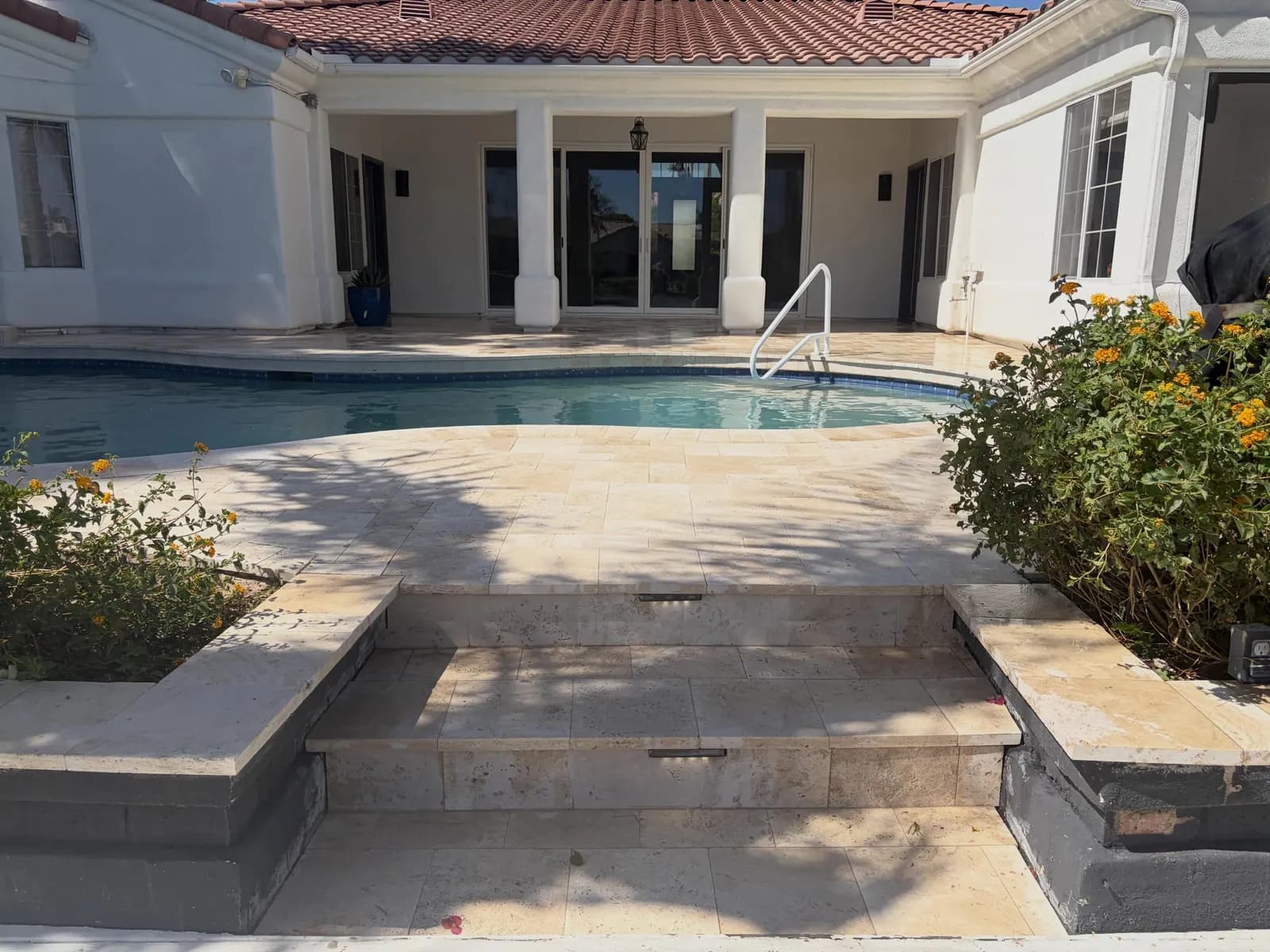
A pair of planters can frame a set of steps, the way the two in the work frame the steps up to a pool deck, and a long one can finish the open side of a patio.
It keeps the soil where it belongs
Walls and a cap hold the soil in one place, off the paving and out of the gravel, so the bed stays tidy between waterings and the edges stay sharp.
It matches the stone around it
The faces and the cap can follow the walls, the fire pit or the island nearby, so the planter looks built with the yard instead of set down in it.
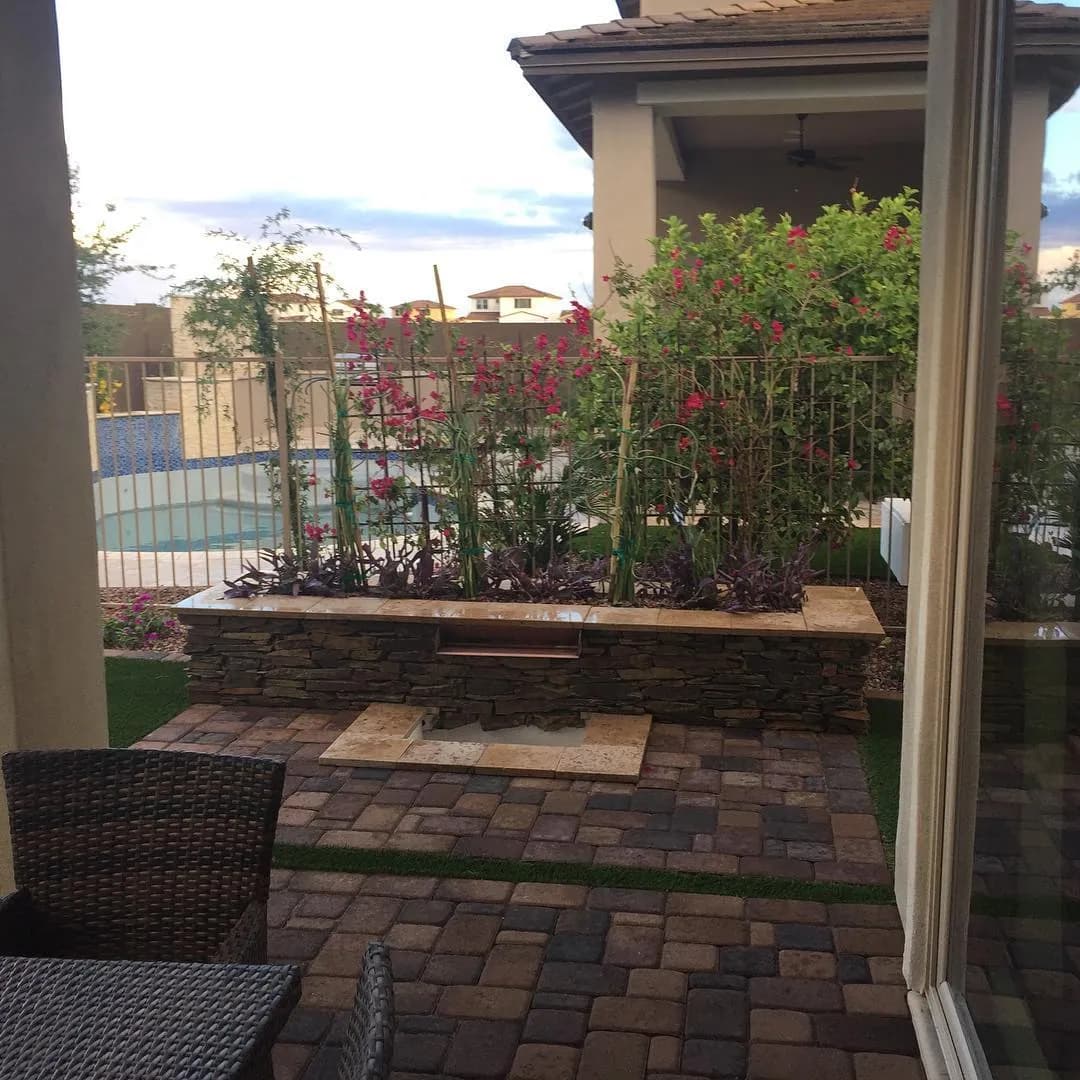
The two planters shown here take two different faces: dark stacked stone with a travertine cap and a small spillway, and coated block with cream travertine caps that match the steps between them. Either way, the cap is the part people touch and sit on, so it is chosen with the patio in mind.
The planters in the work hold orange lantana and red bougainvillea, two plants you will see in many East Valley yards. What goes in yours, and how it is watered, is settled with you at the first contact.
Why a raised bed suits Arizona soil
University of Arizona Extension’s gardening guides make the case for raising the soil.
Caliche layers in Arizona soil block roots, water and drainage, and University of Arizona Extension names raised beds as a way around them.
A raised bed gives better control of soil quality, pH and drainage than a yard’s native ground.
Extension recommends soil at least 12 to 18 inches deep for most vegetable crops.
A bed about 4 feet wide is easy to reach across; one reached from a single side is kept to about 3 feet.
Raised beds vary in height, and 18 to 24 inches is fairly common, Extension notes.
In Arizona, concrete block beds conduct more heat into the soil than some materials, which can stress plants.
Keeping the face clean
The Brick Industry Association says a masonry planter must drain, and weep holes near the base are one way.
A planter built with a closed bottom needs its own drain.
Waterproofing the inside face keeps wet soil from staining the outside with efflorescence.
Masonry touching soil can draw up salty ground moisture, which leaves deposits on the surface.
A surface coating alone is not the fix; keeping water and salts out by design is.
The white deposit is unwelcome, but it usually does not harm the masonry.
Built like a small wall that holds soil
Planter walls hold soil back, so the Brick Industry Association asks that they be checked for its sideways pressure.
It recommends Type M or Type S mortar for garden structures such as planters.
A cap sloped on top sheds water instead of letting it pool.
An open bottom lets weeds and gophers in from below, University of Arizona Extension warns.
Before footing work, Arizona 811 marks buried lines for free, the Arizona Corporation Commission says.
Planters follow each town's wall rules
A planter is held to the same town wall rules as a garden wall, so its height and its spot near a street corner matter.
License, height, drainage and cost.
Not answered here? Ask about your planters on the phone or in your estimate request.
Can I check the license of the company that builds my planters?
Yes. Big B's has held Arizona contractor license ROC 153059 since 2000, and the Registrar's public contractor search shows the license as active.
What goes into a raised planter quote?
Its place in the yard, its length, width and height, the face and the cap. The plants, and how they are watered, are yours to choose; say on the walk what you plan to grow, so the size suits it.
How tall should a raised planter be?
Tall enough to bring the plants up where you see them, and, if you like, low enough that the cap doubles as a seat. Many planters beside a patio are built near seat height for that reason. The height for yours is chosen on the walk, with the steps, walls and seating around it in view.
Does a raised planter need drainage?
Yes. Water has to be able to leave the soil, or the bed stays soggy and the faces stain. How your planter drains, and where that water goes on the patio, is part of its quote.
What does a raised planter cost?
Size sets most of it: how long, wide and tall the planter is. The face and the cap come next, then anything around it, such as steps it frames. The estimate is free.
Are concrete block planters bad for plants?
Not bad, but warm: University of Arizona Extension notes that block conducts more heat into the soil in Arizona, which can stress plants. Watering, shade and what you plant matter, and a waterproofed inside face keeps the outside clean.
How deep should the soil in a raised planter be?
University of Arizona Extension recommends at least 12 to 18 inches for most vegetable crops; ornamental plants vary. What you plan to grow sets the depth, so say so on the walk.
How do you stop white stains on a planter?
By design rather than by coating: the Brick Industry Association recommends waterproofing the inside face and letting the planter drain, because a surface coating alone does not control efflorescence.
Raised bed and masonry guides cited here
5 sources
- School Garden Planning and Design, University of Arizona Cooperative Extension
- Backyard Gardener #26: Raised Beds Construction, University of Arizona Cooperative Extension, Yavapai County
- Technical Notes 29B, Brick Industry Association
- Technical Note 23A, Efflorescence, Brick Industry Association
- Call Before You Dig, Arizona Corporation Commission
Let's bring the green up to eye level.
Tell us what you have in mind. The consultation and the estimate are free.

Licensed in Arizona since 2000, ROC 153059